
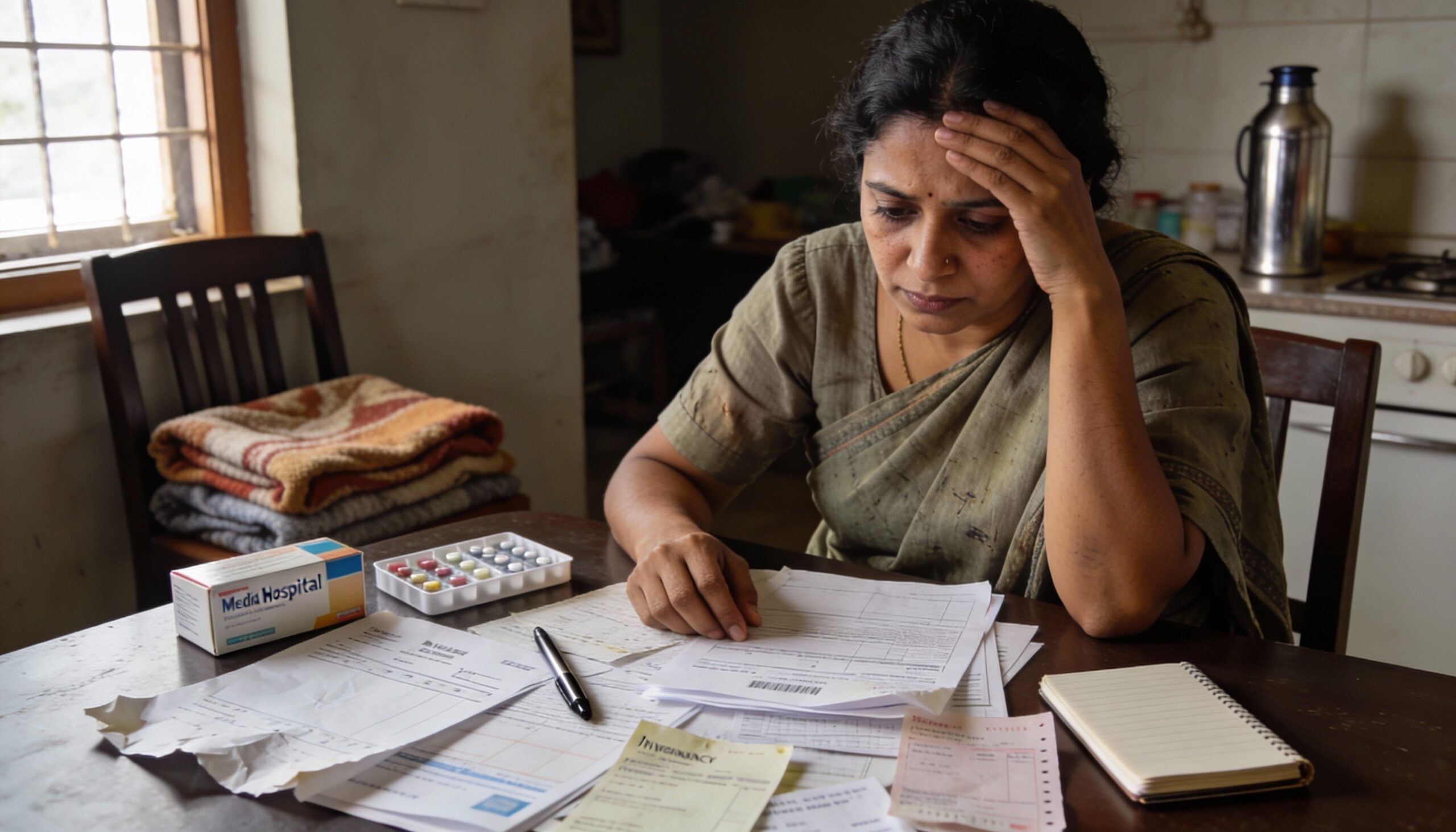
Money matters. And how.
A close friend once confided in me about the financial strain she was facing while caring for her terminally ill mother. Her voice carried exhaustion not just emotional, but economic. Listening to her, I found myself sharing a story I rarely speak about.
When my mother-in-law was undergoing treatment for cancer, we were prescribed injections that cost over one lakh rupees each. There was no insurance coverage. What followed was a desperate scramble moving from one office to another, pleading for subsidies, searching for charitable support, negotiating timelines, calculating what could be postponed and what could not. It was a harrowing phase. And yes, I am relieved it is over but the memory of that financial helplessness still lingers.
Talk to any caregiver, and you will hear this echoed again and again: financial stress is one of the heaviest, most persistent burdens of caregiving. Studies and lived experiences suggest that nearly 90% of caregivers worry deeply about money often silently.
The Everyday Cost of Care
Caregiving is rarely a short-term responsibility. For many families, it extends over months or years dialysis sessions several times a week, physiotherapy after surgery or stroke, long-term medications, nutritional supplements, medical equipment, transport to hospitals, and frequent investigations.
Even when major hospital expenses are managed, out-of-pocket costs continue to accumulate. Depending on location, access to public healthcare, and disease severity, families may spend anywhere between ₹20,000 to ₹40,000 per month, and often much more. These expenses quietly disrupt household budgets, savings plans, children’s education funds, and retirement security.
What makes this especially difficult is that caregiving expenses are often:
- Unpredictable
- Urgent
- Non-negotiable
You cannot delay treatment because a salary is late or savings are exhausted.
Care Work: Essential, Yet Economically Invisible
In recent years, there has been growing global recognition of care work but recognition has not always translated into economic valuation or policy protection.
Care work includes all activities that sustain life and well-being caring for children, the elderly, the sick, and persons with disabilities. This work can be paid or unpaid, but both are essential for society to function.
The Care Economy (Often Referred to as the “Purple Economy”)
The care economy encompasses:
- Paid care work: nurses, healthcare aides, domestic workers, teachers, childcare providers
- Unpaid care work: cooking, cleaning, caregiving tasks largely performed within households and overwhelmingly by women
Despite its immense value, unpaid care work remains largely excluded from economic calculations like GDP.
In India, this imbalance is stark.
According to the Time Use Survey (2019):
- Women spend nearly 312 minutes per day on unpaid domestic and care work
- Men spend only 52 minutes per day
This unequal distribution has far-reaching consequences not just socially, but economically.
Why India Urgently Needs to Center Care in Economic Policy
1. Demographic Shifts Are Reshaping Care Needs
India is undergoing a major demographic transition.
Data from the United Nations Population Fund (UNFPA) indicates that:
- About 25% of India’s population is below 14 years of age
- 10.5% is above 60 years, translating to nearly 147 million elderly persons
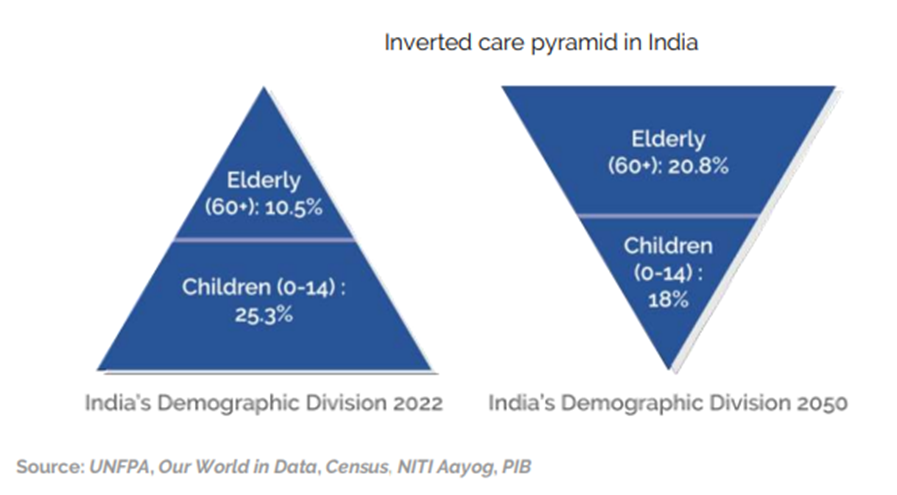
Together, this means over 500 million people currently require care.
By 2050:
- The elderly population is expected to rise to 20.8%, or nearly 347 million people
- Although the proportion of children may reduce slightly, their absolute numbers will remain close to 300 million
This growing demand for care will place unprecedented pressure on families—particularly women.
2. The Multiple Care Burden on Women
Women in India often shoulder layered caregiving responsibilities:
- Childcare
- Elder care
- Caring for sick or disabled family members
- Managing household work
Research shows that women aged 15–64 spend nearly three times more time on unpaid domestic work than men. This imbalance directly affects:
- Workforce participation
- Career progression
- Income stability
- Financial independence
For many women, caregiving becomes the invisible reason behind interrupted careers, reduced earnings, and long-term economic vulnerability.
The Financial Ripple Effect of Caregiving
The financial burden of caregiving extends beyond immediate medical costs.
It includes:
- Loss of income due to reduced work hours or job exit
- Increased healthcare expenses for the caregiver due to stress-related illnesses
- Long-term impact on savings, pensions, and retirement security
- Intergenerational effects, where children’s opportunities are indirectly affected
Caregivers often absorb these costs quietly, driven by love, duty, and social expectations but silence should not be mistaken for sustainability.
Why Current Systems Fall Short
Despite the scale of caregiving in India:
- Caregivers rarely receive direct financial support
- Insurance coverage for long-term and home-based care is limited
- Social security systems inadequately recognize unpaid care work
- Employer policies often fail to accommodate caregiving responsibilities
The result is a system where caregiving is essential, yet economically penalized.
What a Care-Centered Economic Approach Could Look Like
Centering care in economic policy is not charity , it is strategic investment.
Some key measures could include:
- Financial allowances or tax benefits for family caregivers
- Expansion of insurance coverage to include long-term and home-based care
- Public investment in affordable care services
- Flexible workplace policies and caregiver leave
- Recognition of unpaid care work in national economic accounting
Such measures would not only support caregivers but also strengthen healthcare systems, improve workforce participation, and promote gender equity.
Reimagining Care as an Economic Pillar
Care is not a personal issue , it is a public good.
When caregiving collapses under financial strain, the consequences spill over into healthcare systems, labor markets, and social stability. Conversely, when caregivers are supported, societies become more resilient.
The question is not whether India can afford to invest in care but whether it can afford not to.
Conclusion: Making the Invisible Visible
Centering care in India’s economic policy is no longer optional , it is essential.
Recognizing the financial value of care work is a critical step toward:
- Gender equality
- Stronger social welfare systems
- Sustainable and inclusive economic growth
Caregivers are not just supporting individuals; they are sustaining families, communities, and the nation itself. Their work deserves visibility, protection, and respect.
As India continues its journey toward development, it is time to acknowledge a simple truth:
An economy that does not value care is incomplete.
When care work is recognized, supported, and fairly distributed, we move closer to a society that is not only productive but humane.