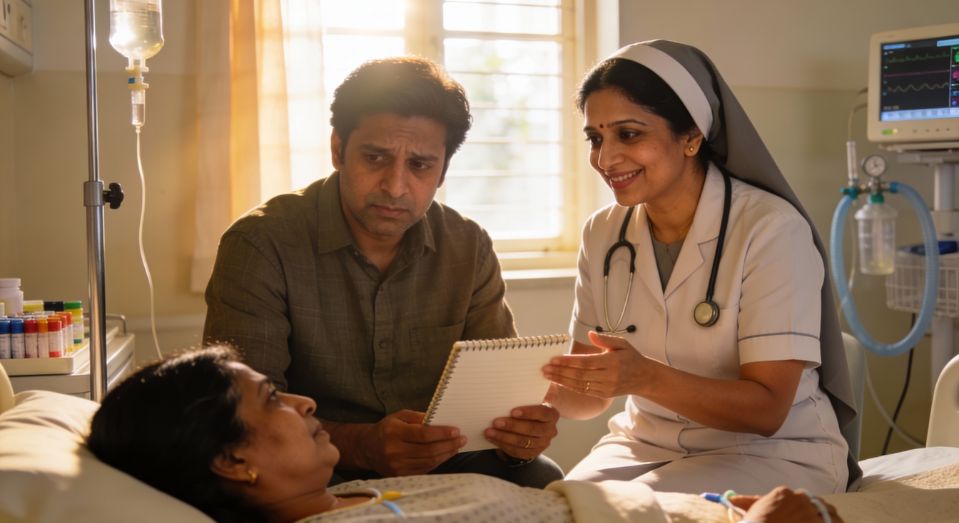
Sister Manju that was how everyone addressed her. And every single time, she responded with the same warmth: a gentle smile, steady eye contact, and an unmistakable willingness to help.
I met her at a hospital more than a decade ago, when my mother-in-law was admitted for knee replacement surgery. It was a routine procedure by medical standards, but for us as a family and for me as an informal caregiver , it was anything but routine. Hospitals have a way of overwhelming you, especially when you are suddenly expected to understand medical terms, postoperative care, mobility restrictions, medications, and discharge instructions, all while managing your own worry.
It has been over ten years since that hospital stay, but I still remember Sister Manju vividly. I remember her words, her calm explanations, the way she never made me feel foolish for asking the same question twice. More importantly, I remember her teachings not just about care tasks, but about confidence. Looking back, I realize this lasting impact was not because of extraordinary medical interventions, but because of her exceptional communication skills.
Why Nurses Matter So Deeply to Caregivers
It is not uncommon for informal caregivers to develop a rapport with nurses during a hospital stay. In fact, caregivers often interact far more frequently with nurses than with doctors. While physicians typically make brief, focused rounds, nurses are present continuously—monitoring, assisting, observing, responding, and explaining.
For caregivers, nurses often become:
- Translators of medical language
- Guides through unfamiliar routines
- Reassuring presences during moments of panic
- Teachers preparing them for life after discharge
This proximity naturally fosters trust. Caregivers begin to rely on nurses not only for patient care, but for emotional grounding.
And this relationship becomes especially critical at one pivotal moment: discharge.
The Discharge Moment: Where Anxiety Peaks
At the time of discharge, the responsibility of care shifts abruptly. The hospital environment with its alarms, protocols, and trained professionals gives way to the uncertainty of home.
It is usually the nurse who sits with the caregiver, explains the discharge summary, reviews medications, demonstrates procedures, and answers last-minute questions. This interaction is often the caregiver’s final safety net before stepping into a role they may feel wholly unprepared for.
Yet research suggests that this crucial interaction is increasingly under strain.
A study published in BMC Nursing (2021) by Kwame & Petrucka highlights that due to systemic and organizational pressures, the time nurses are able to spend communicating with caregivers has been steadily decreasing. Staffing shortages, increased patient loads, documentation demands, and institutional constraints all limit meaningful caregiver–nurse interaction.
The irony is painful: just as caregivers need more guidance, reassurance, and clarity, the opportunity for communication is shrinking.
Why Communication Is Not a “Soft Skill”
Communication is often dismissed as a “soft skill” something nice to have, but secondary to clinical competence. Research tells us otherwise.
Studies consistently show that open, supportive communication between informal caregivers and nurses leads to measurable improvements in caregiver well-being. According to Steffen et al. (2019), caregivers who experience effective communication with nursing staff report:
- Reduced emotional distress
- Lower depressive symptoms
- Improved physical coping
- Greater confidence in managing care tasks
In other words, communication is not just comforting—it is protective.
For caregivers, good communication can mean the difference between:
- Confidence and constant self-doubt
- Calm vigilance and chronic anxiety
- Sustainable caregiving and burnout
The Emotional Landscape of the Informal Caregiver
Informal caregivers often enter their role without preparation. They are spouses, children, in-laws, siblings people who love deeply but are rarely trained for the clinical realities they suddenly face.
They carry:
- Fear of making mistakes
- Guilt for feeling overwhelmed
- Pressure to “be strong”
- Anxiety about outcomes they cannot control
What many caregivers need in these moments is not just information, but validation.
Simple questions like:
- “How are you feeling about taking this on?”
- “What part worries you the most?”
- “Would you like me to go over that again?”
can profoundly alter a caregiver’s internal experience.
What Research Tells Us About Effective Caregiver–Nurse Communication
Multiple studies have identified key features of effective interpersonal communication between nurses and informal caregivers. These include:
1. Sitting With the Caregiver
Not standing at the door. Not rushing through instructions. Sitting down conveys presence, respect, and availability. It signals that the caregiver’s understanding matters.
2. Encouraging Questions
Caregivers often hesitate to ask questions for fear of appearing ignorant or burdensome. Explicitly inviting questions normalizes uncertainty and reduces anxiety.
3. Checking Emotional Readiness
Asking caregivers how they feel about the added responsibility acknowledges the emotional labor of caregiving. It transforms the interaction from transactional to relational.
4. Providing Tangible Resources
Written instructions, demonstration videos, helpline numbers, and follow-up contacts empower caregivers beyond the hospital setting.
5. Offering Encouragement
Simple affirmations “You’re doing well,” “You’re not alone,” “What you’re doing matters”—help caregivers internalize confidence and purpose.
Research shows that these communication behaviors contribute directly to improved caregiver coping and patient outcomes.
The Ripple Effect of One Nurse’s Words
When I think back to Sister Manju, I realize she did all of these things intuitively.
She sat with me.
She encouraged my questions.
She noticed my hesitation.
She explained without rushing.
She reminded me that caregiving was a shared responsibility.
Her words stayed with me long after the hospital stay ended. They shaped how I approached caregiving later in life especially during far more complex and emotionally charged situations.
Systemic Challenges and Why Awareness Matters
It is important to acknowledge that nurses often operate under immense pressure. Time constraints, administrative demands, and staffing shortages make extended communication difficult.
But recognizing communication as a core component of care—not an optional extra—can influence:
- Hospital policies
- Discharge planning protocols
- Training programs
- Caregiver support initiatives
When healthcare systems invest in communication, they invest not only in patients, but in the invisible network of caregivers sustaining them.
What Caregivers Can Advocate For
While systemic change takes time, caregivers can gently advocate for themselves by:
- Asking for clarification without apology
- Requesting written or visual aids
- Voicing concerns about readiness
- Asking who to contact after discharge
These are not signs of inadequacy they are signs of responsibility.
A Final Reflection
Caregiving is not just a physical task. It is an emotional, psychological, and relational journey.
And communication clear, compassionate, respectful communication—is the thread that holds this journey together.
Years later, I may not remember every medication name or instruction, but I remember how Sister Manju made me feel: capable, supported, seen.
For a caregiver, that feeling can be everything.