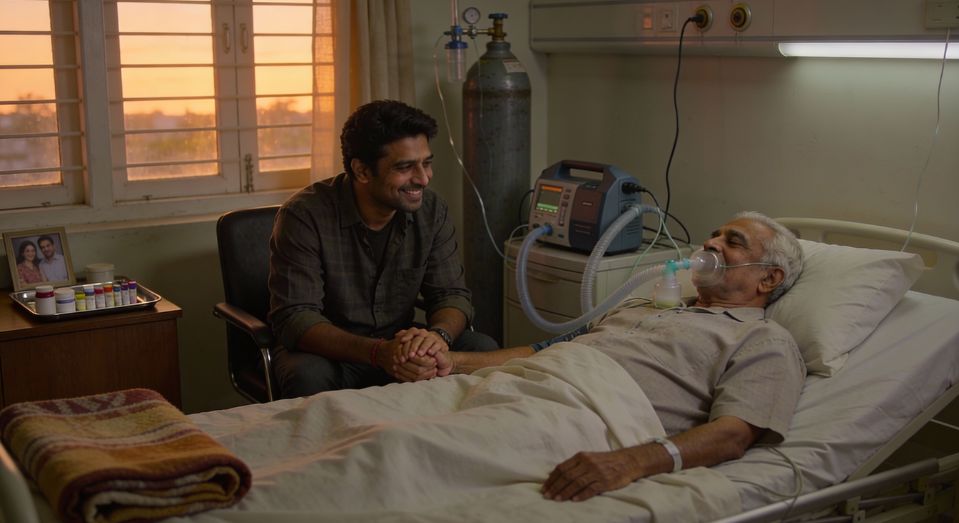
Last Christmas and my birthday which fall in the same week—I spent them in a hospital room with my 92-year-old father. We had just shifted from the ICU to a private room. He was slowly recovering from a near-fatal episode of sepsis. Along with his age, he had multiple co-morbidities, but the doctors reassured me that he was doing well. By New Year’s Eve, we were relieved and happy to be discharged.
If there were an award for acting, I would have won it hands down—because everyone thought I was the happiest person going home. Smiles, gratitude, polite nods. But the truth was far from it. Inside, I was terrified. I was trying my best to be brave.
Fear.
Is that an emotion we usually associate with a caregiver who is taking their loved one home?
Not really.
Yet research tells a very different story.
Caregiver Fear: What the Research Says
Multiple studies across countries and caregiving contexts consistently report that between 60–80% of informal caregivers experience significant anxiety or fear, particularly during care transitions, such as hospital discharge.
According to the American Psychological Association (APA) and Family Caregiver Alliance:
- Caregivers often report anticipatory anxiety—fear of what might go wrong
- Anxiety peaks when professional supervision reduces and responsibility increases
- Caregivers of elderly patients with complex medical needs are at especially high risk
A landmark review published in The Gerontologist reported that:
“Caregiver distress is not solely linked to caregiving workload but to perceived responsibility, uncertainty, and fear of making irreversible mistakes.”
In simple words: fear is not hypothetical, it is situational, learned, and deeply rational.
What Are Caregivers Afraid Of?
When I finally allowed myself to acknowledge my fear, it took shape as questions that wouldn’t leave my head:
- How will I manage everything at home?
- Who will help me if something goes wrong at 2 a.m.?
- How will I feed through the tube correctly?
- What if I miss a warning sign?
- What if I am not enough?
Research categorizes these fears into four main domains:
- Fear of Harm
Making medication or procedural errors
Missing symptoms of deterioration - Fear of Inadequacy
Feeling untrained, unprepared, or “not medical enough”
(Journal of Advanced Nursing, 2018) - Fear of Isolation
Loss of immediate professional backup
Limited social or family support - Fear of the Future
Disease progression
Rehospitalization or death
These fears are amplified by emotional attachment—this isn’t a patient, this is your person.
The Psychological Cost of “Being Brave”
Caregivers are often praised for being “strong,” “selfless,” and “resilient.” While well-intentioned, this narrative can be harmful.
A 2020 study in BMC Public Health found that caregivers who suppress fear and distress are more likely to develop:
- Chronic anxiety
- Depression
- Sleep disorders
- Hypertension and metabolic issues
In fact, long-term caregivers have been shown to have higher mortality rates than non-caregivers of the same age group (Schulz & Beach, JAMA, 1999).
Fear, when unacknowledged, does not disappear , it transforms into burnout.
Why Talking About Fear Matters
Recognizing caregiver fear:
- Normalizes emotional responses
- Reduces guilt and self-blame
- Encourages help-seeking behavior
- Improves caregiving outcomes
The World Health Organization now recognizes informal caregivers as a “hidden healthcare workforce” and emphasizes the need for emotional and psychological support alongside training.
Fear does not mean you are failing.
Fear means you understand the weight of what you are holding.
So—Are Caregiver Fears Real or Hypothetical?
They are real.
They are evidence-based.
And they deserve acknowledgment.
Caregiving is not just an act of love , it is a sustained psychological load carried quietly. If you are afraid, you are not weak. You are human.
This is where the conversation must begin.